
|
||
Runtime Performance Enhancements for Plates and Finite Volumes in HIFREQThe paper titled “Runtime Performance Enhancements for Plates and Finite Volumes in HIFREQ” presents an interpolation-based acceleration enhancement implemented in the HIFREQ computational module of MultiFields for models involving finite soil volumes, metallic plates, and wires in multilayered soil environments. The enhancement targets repeated Green’s function evaluations associated with two-dimensional sources on surface elements, or patches, which represent a major computational cost in models with numerous patch-to-wire and patch-to-patch interactions. By using interpolation tables for these Green’s function calculations, the implemented method reduces computation time while preserving the accuracy of the existing finite volume and plate formulations in multilayered soil environments. The improvement was assessed through impedance calculation benchmarks with varying numbers of surface elements for both finite volume and plate models. The finite volume benchmark considered a tower footing surrounded by a finite backfill region in a two-layer soil environment, where the relative error remained below 0.009% and the runtime reduction reached approximately 35–59%, depending on the number of patches. The plate benchmarks considered buried stainless-steel and magnetic-steel plates, with relative errors of about 0.1% and runtime reductions of approximately 88–95% for the stainless-steel plate and 91–96% for the magnetic-steel plate. These results show that applying interpolation-based acceleration to both wires and patches preserves the accuracy of the computed impedances while providing significant runtime improvements for finite volume, and metallic plate formulations. The practical value of the enhancement is demonstrated through two practical engineering applications, with their cross sections shown in the following figure. The first involves a faulted cable inside a rebar-reinforced air tunnel, where the air region is modeled as a finite volume to capture electromagnetic coupling among cables, ground continuity conductors (GCCs), rebars, grounding grids, and surrounding soil, while step and touch voltages are assessed; this model achieved approximately 27% runtime reduction. The second evaluates the shielding effectiveness of a steel gutter surrounding trefoil power cables using magnetic plate modeling, achieving approximately 50% runtime reduction. In both applications, applying acceleration to both wires and patches improved runtime performance while preserving the reliability of the computed results. 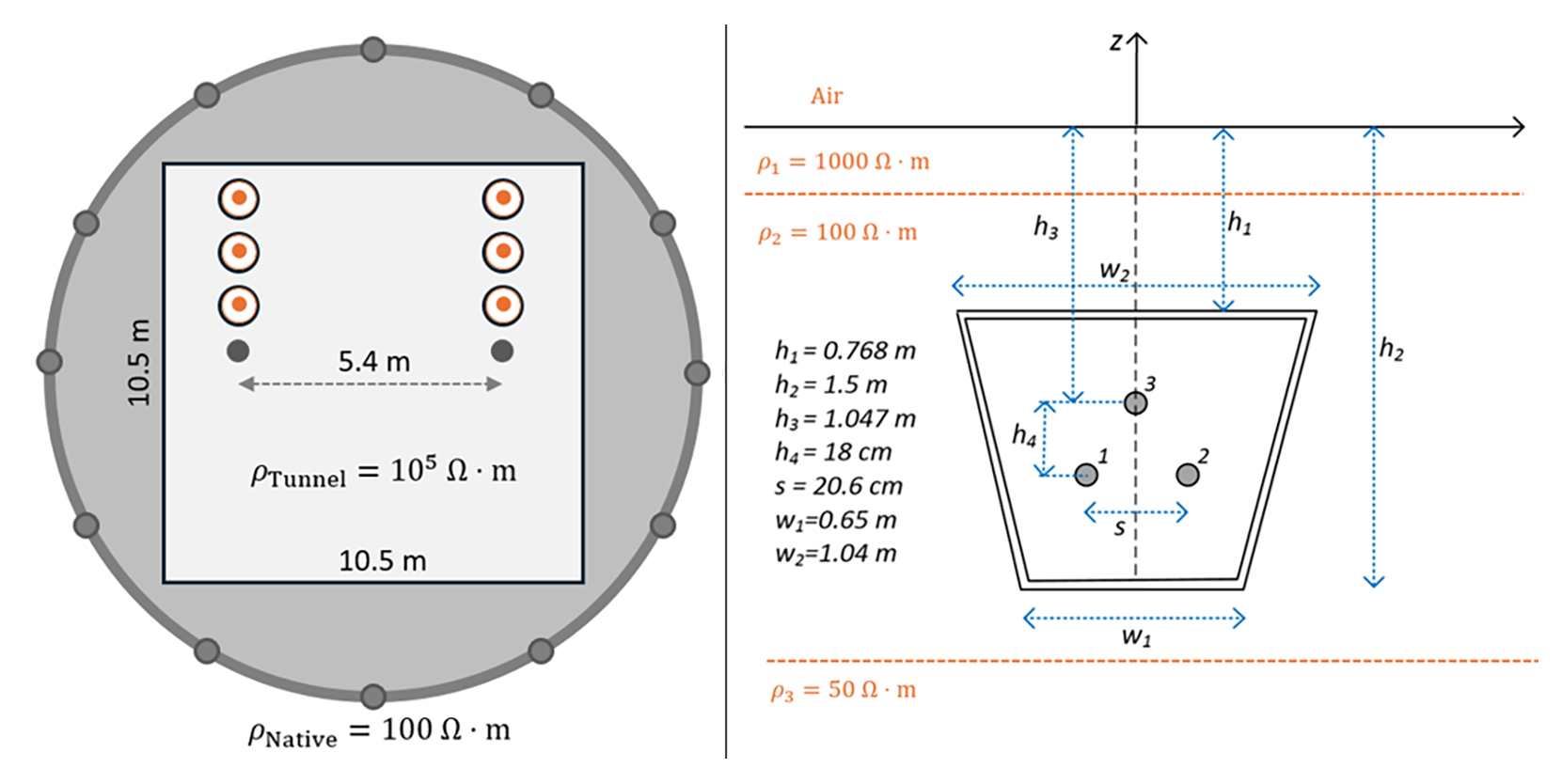
Geometry and cross section of the practical applications considered: (left figure) Overall, the implemented interpolation-based acceleration method, applied to both wires and patches, significantly improves the runtime efficiency of MultiFields for complex models involving finite volumes and plate structures. The benchmark studies confirm that the method provides substantial runtime reductions with negligible loss of accuracy, while the practical applications show that the enhancement is effective for large-scale engineering studies involving numerous electromagnetic interactions. |
||
|
||
|
SES & technologies ltd. 3055 Blvd. des Oiseaux, Laval, Quebec, Canada, H7L 6E8 +1 (450) 622-5000 info@sestech.com ©2026 SafEngServices & technologies ltd. |